Stop Oversharing With AI: Your Deepest Secrets Don’t Belong on Google

You Should Never Share Anything Personal With ChatGPT
So folks, welcome to another episode of Nischal vs. the AI Apocalypse.
This one’s spicy because, yeah, people are spilling their hearts to ChatGPT like it’s their BFF therapist—and turns out, it’s basically shouting that to the internet.
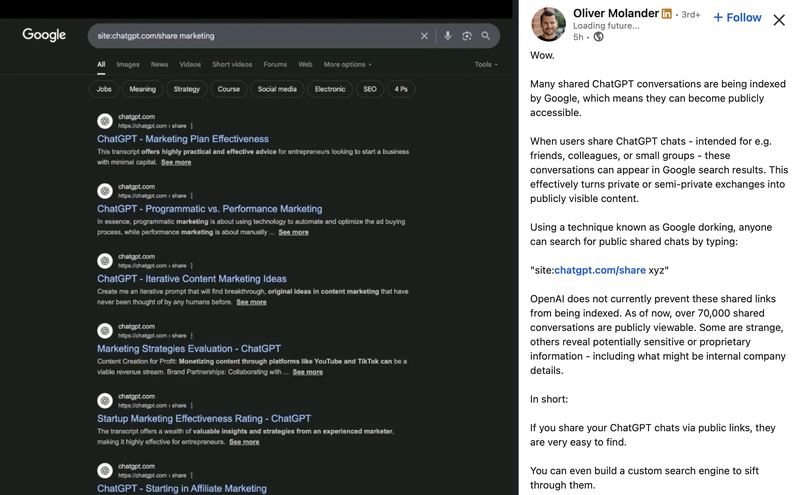
I’m serious. All those convos you thought were private? Many were indexed by Google. That means your “Dear ChatGPT, I’m lonely and hate my job” is one search query away from going viral (for all the wrong reasons).
And before you act smart—“Ahhh Nischal, we’re not dumb like you to share things online”—cool, me neither. I only had exam notes in there… (don’t fact check that). But the thing is, OpenAI gave us the perfect trap:
- Share your chat → tick the little “Make Discoverable” box (because it looked required) → boom, it’s public.
- Now anyone with
site:chatgpt.com inurl:/sharecould find your stuff faster than your mom finding your hidden Maggi stash in home.
When Even Sam Altman Says, “Don’t Do It”
Here’s where it gets wilder:
Sam Altman, CEO of OpenAI, literally said people use ChatGPT as a therapist, life coach, even relationship guru. And then—get this—all that intimate stuff was searchable.
It’s like telling a robot your deepest secrets, and the robot just… puts it on Google.
“People use it—young people, especially—as a therapist, a life coach; having these relationship problems and [asking] ‘what should I do?’” — Sam Altman, TechCrunch
Oh, and legally, OpenAI has to keep your chats and can share them in case of lawsuits.
So basically, anything you say can and will be used against you in the court of LAW.
(WTH, am I getting arrested by my own chatbot?)
Where the Internet Lost Its Mind (PCMag Update)
Just when I thought this was peak chaos—PCMag drops a bomb:
“After backlash, ChatGPT removes the option to have private chats indexed by Google.”
Yep, OpenAI literally had to yank a feature because people were unknowingly putting their private therapy sessions, relationship drama, and wild conspiracy theories on Google search.
Now, OpenAI removed the “Make Discoverable” checkbox and started scrubbing old links, but Bing and DuckDuckGo still show them as of this writing. Translation: the internet doesn’t forget because OpenAI clicked undo.
Sam Altman’s quote suddenly hits harder. People literally turned ChatGPT into their emotional dumping ground—and it went public.
(Black Mirror episode intensifies.)
My Product Designer Take (aka “Why Did This Feature Even Exist?”)
Here’s where I flip from “ranting user” to “product designer who actually builds stuff.”
That Make Discoverable checkbox? Chef’s kiss bad design.
- It looked mandatory because of its placement and tiny print—classic dark pattern vibes.
- The feature shipped without strong “Are you SURE you want this public?” guardrails.
If I designed this, I’d:
- Make public sharing an explicit, friction-heavy flow (multi-step, scary red warnings).
- Default to private always, because people’s lives aren’t content fodder.
- Build in auto-expiry for shared links (imagine your convos self-destructing like Mission Impossible).
We keep talking about “responsible AI,” but this? This was reckless UX at scale.
I’ve been designing interfaces that make users think more, not panic later.
Want to see my take on non-zombie, privacy-first tech? Check out my portfolio—I design to keep people in control, not accidentally trending on Google.
So How the Heck Do You Protect Yourself?
Don’t Treat ChatGPT as Your Therapist
- If you wouldn’t post it on your Insta story, don’t type it into ChatGPT.
- AI can feel “safe” but it’s still feeding on your data like it’s free samosas at an office party.
Use Local AI Like Ollama
- Want the AI magic without the oversharing nightmare? Use Ollama or similar apps. They run locally, offline, and keep your data on your machine.
- Basically, your laptop = your private AI, no snitching to Big Tech.
Audit Your Shared Links
- If you ever hit “share” on ChatGPT, go back and unpublish or delete those links. Don’t assume “private” means private—it doesn’t.
Stop Being Lazy With Privacy
- Take 5 minutes to actually read what you’re sharing and with whom. Or at least pretend to care—your future self will thank you.
Final Word
Look, I’m not anti-AI. I literally use it every day. But giving it your raw emotions, secrets, and trauma dumps? Nah fam, that’s a one-way ticket to embarrassment land.
OpenAI already had to backpedal because oversharing became a global SEO goldmine. Don’t wait for the next “oops, your secrets are trending” headline. Use AI smart, keep it local when possible, and for the love of privacy—don’t tell it stuff you wouldn’t even tell your diary.
Your brain, your secrets, your call. Protect them.
References:

About Nischal Skanda
Nischal is a technology enthusiast and designer passionate about the intersection of AI, cognitive science, and human-computer interaction. He explores how emerging technologies impact our daily lives and shares insights on building better digital experiences.