The Cycle of AI: How Your ₹2,000 Subscription Funds a $5,000/Month GPU
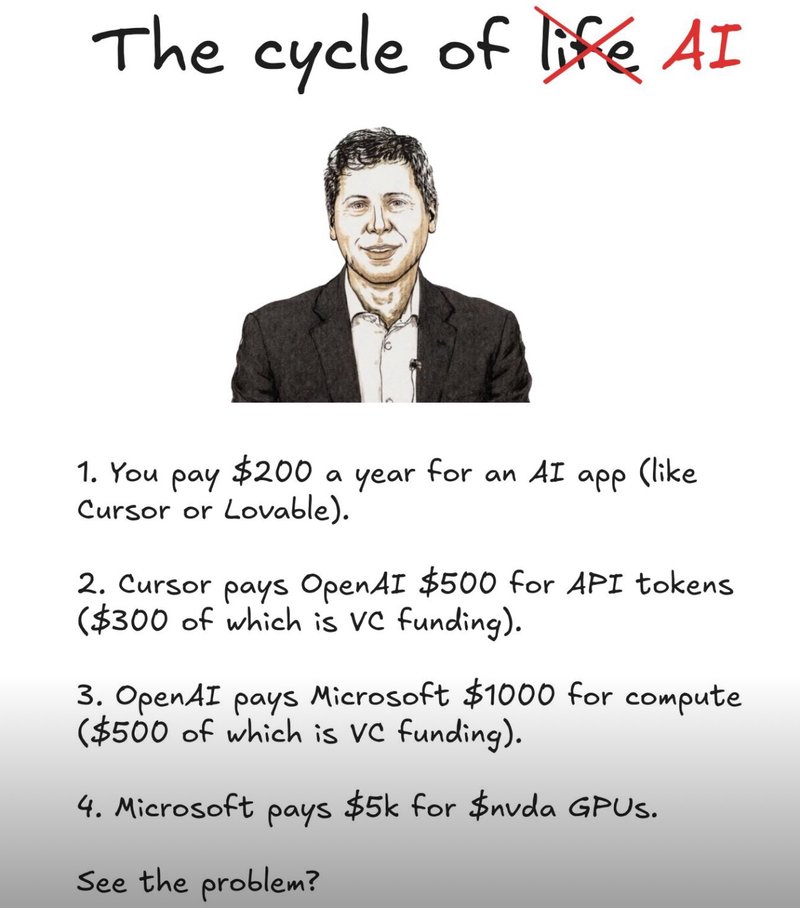
“You pay a neat little fee for an AI app. That cash takes a theme-park ride: tokens → cloud GPUs → power bill → NVIDIA’s earnings call. The only folks sleeping well? The people selling shovels in the gold rush.”
TL;DR
You pay a neat little fee for an AI app. That cash takes a theme-park ride: tokens → cloud GPUs → power bill → NVIDIA’s earnings call. The only folks sleeping well? The people selling shovels in the gold rush. Meanwhile, enterprises burn money on “pilots,” electricity prices climb, and capex goes brrr. Is this dot-com déjà vu? Insaneeee. Only this time the write-offs are concrete and substations, not .com logos. 1 2 3
The meme is hilarious because… no shit, it’s the actual flow
You → App → OpenAI → Microsoft/AWS/Google → NVIDIA → Power companies. Tiny stream (you). Big river (them).
Real prices, not vibes:
- Cursor now sells an Ultra plan at $200/month for compute-hungry power users. Teams is $40/user/mo. What the HELL, that escalated fast. 4
- Lovable: $25/month Pro. Budget dev dopamine. 5 6
Now the brick wall: model pricing. OpenAI’s GPT-5 posts $1.25 per 1M input tokens and $10 per 1M output tokens. The “cheap” GPT-5 mini is $0.25 in / $2 out. Output is the wallet-killer. (Because generating long, “smart” text eats compute like jalebis at a wedding.) 7
Quick human math: a single power user who munches 60M input + 12M output tokens in a month on GPT-5 racks up ≈$195 in API cost alone. There goes your ₹2k, before you even pay for auth, storage, support, or—minor detail—the product team. This is why “unlimited” plans quietly… aren’t. And yes, cost-per-token is dropping while tokens-per-task explodes (agents, long context, tool calls = token buffets). WSJ literally called out that paradox. 8
Upstream is where the money actually lives (bring a helmet)
The hyperscalers are not play-acting; they’re paving cities. Analysts peg Big Tech’s 2025 AI capex around $344B, with some trackers saying it’s gliding toward $400B+ next year. Microsoft alone guided to ~$30B in a single quarter. That’s not “move fast and break things”; that’s pour concrete and bend GDP. 9 10 1
Who’s catching the waterfall? NVIDIA just printed $46.7B revenue in a quarter, $41.1B from data center. Translation: the shovel store has a line out the door. 2
GPUs: you don’t buy compute—you feed it rent every hour
Don’t own GPUs? You’re renting the treadmill. An Azure H100 VM is about $6.98/GPU-hour; run it 24×7 and it’s ~$5,095/month… for one GPU. Real workloads use racks. Your token bill hasn’t even said hello yet. 11 12
Own the silicon? Cool flex. Blackwell arrives and makes last year’s kit look like dial-up. Hardware obsolescence moves faster than the 5-year depreciation schedule your accountant swears by. Corporate finance says “asset”; physics says “upgrade, buddy.” (And NVIDIA’s release cadence keeps receipts.) 2
The denominator: electricity (aka “did my power bill just… double?”)
The IEA projects data-centre electricity demand roughly doubling by 2030 to ~945 TWh, up from ~1.5% of global electricity in 2024. AI is the big driver. That’s not a blog-boy opinion piece; that’s the energy people. 13
And the U.S. grid? A lot of it was built in the 1960s–70s; ~70% of transmission lines are 25+ years old. Try bolting gigawatt-scale data centres onto that antique. Spoiler: utilities ask regulators for rate hikes, and the rest of us subsidize chatbot latency. Nincompoops will say “just build more.” Sure, after permits, transformers, land, cooling, interconnects… see you in 2030. 14
“But surely the business value is massive?”
Let’s be adults. A brand-new MIT study lighting up headlines says ~95% of enterprise GenAI pilots show no measurable ROI yet. Not “zero benefit” in life; just “nothing that Finance can circle with a pen.” That’s… a lot of POCs and not a lot of P&L. (Yes, it’s early; yes, the stat’s being debated; but the vibe in boardrooms is exactly this.) 15 16
Meanwhile, shovel-sellers keep selling shovels. Again: $41.1B data-centre revenue—in one quarter—for NVIDIA. No further questions, your honour. 2
Dot-com déjà vu, but with transformers instead of fiber
Wall Street houses are openly modeling ~$2.9T in global data-centre capex by 2028, with a ~$1.5T financing gap that debt markets will need to fill. What the HELL. If demand under-delivers, we don’t just mothball swag; we strand megawatts and refinance empty buildings. Even the FT is asking, “what if we spend nearly $3T on data centres no one needs?” Tell me that doesn’t smell like 1999 with better lighting. 17 18 19
Okay, so what stops this from becoming a flaming crater?
Boring, disciplined product work. Not launch-day pyrotechnics.
- Token diets: outputs are pricier than inputs; cut verbosity, cap context, kill runaway agents. (OpenAI’s table practically begs you.) 7
- Model tiering: run GPT-5 mini for 80% of jobs, burst to big-brain GPT-5 for the 20% users will actually notice. That swing is the difference between “viable” and “weeping CFO.” 7
- Capacity with contracts: build data centres against committed demand, not vibes. Microsoft’s $30B/quarter should terrify you into grown-up procurement. 1
- Grid-aware growth: site near real power, plan for interconnects, and stop pretending a substation fairy will bless your PDF. IEA’s curves aren’t memes. 3
Where I land (and I say this with love)
I like these tools. They help. They reduce drudge work. They make teams faster when you redesign the workflow instead of duct-taping a chatbot on top. But the money loop today is an upstream transfer: users → tokens → GPUs → utilities → earnings. Until we fix unit economics and power math, this ain’t your iPhone moment. It’s dot-com with a larger electricity bill… crazyyy.
Ship smarter. Spend slower. Save the poetry for launch day; bring a spreadsheet to everything else.
{{ partial “portfolio-cta” (dict “text” “Want to see how I design AI-powered experiences that actually make financial sense?” “section” “projects”) }}
How to Not Light Money on Fire: A Snarky Survival Guide
Because apparently we all need a reminder that “AI first, think later” isn’t a business strategy.
🚨 Emergency Cost-Cutting Checklist
- Audit your token usage - Is that agent really generating 10x more output than input? Probably not.
- Kill the unlimited plans - They’re like all-you-can-eat buffets: great until you realize you’re funding someone else’s yacht.
- Model tiering isn’t optional - GPT-5 mini for the grunt work, save the expensive one for when it actually matters.
- Set output limits - Because nobody needs a 5,000-word essay about why cats are better than dogs.
💡 The “Actually Smart” Playbook
- Start with the problem, not the tech - What are you actually trying to solve? (Hint: It’s not “use more AI”)
- Measure ROI before you deploy - Not after 6 months of “pilots” that go nowhere
- Contract for capacity - Don’t build data centers on vibes
- Power matters - Site near actual electricity, not just good WiFi
😤 Signs You’re Doing It Wrong
- Your CFO cries when the cloud bill arrives
- Your data center uses more electricity than a small city
- You’re explaining to investors why “AI transformation” means “we spent $50M and got a chatbot”
- NVIDIA’s earnings make you physically ill
Pro tip: If your AI costs are growing faster than your revenue, you’re not “innovating” – you’re subsidizing hyperscalers. Fix it before the board notices.
References
Reuters - Microsoft to spend record $30 billion this quarter as AI investments pay off ↩︎ ↩︎ ↩︎
NVIDIA Announces Financial Results for Second Quarter Fiscal 2026 ↩︎ ↩︎ ↩︎ ↩︎
DOE - What does it take to modernize the U.S. electric grid? ↩︎
Fortune - MIT report: 95% of generative AI pilots at companies are failing ↩︎
Digital Commerce 360 - MIT report finds 95% of enterprises see no return on generative AI ↩︎
The Economist - Who will pay for the trillion-dollar AI boom? ↩︎
Financial Times - What’ll happen if we spend nearly $3tn on data centres no one needs? ↩︎

About Nischal Skanda
Nischal is a technology enthusiast and designer passionate about the intersection of AI, cognitive science, and human-computer interaction. He explores how emerging technologies impact our daily lives and shares insights on building better digital experiences.